What if detecting infectious disease were as simple as taking a single breath?
Varro Life Sciences is working to make this dream a reality. Led by co-founder and CEO Tom Cirrito, Varro is developing breakthrough tools that combine advances in nanobody science with rapid-response biosensors. The result is a set of technologies that can detect pathogens in real time, helping protect lives, communities, and economies from disruption.
Varro’s biosensor can deliver a diagnostic result in just 60 seconds from a single breath, while its air bio detector continuously monitors environments for the presence of pathogens. Together, these technologies bring detection into everyday spaces where early insight can have an immediate impact. This shift represents a meaningful expansion of what diagnostics can be.
“It doesn’t just change what we know about diagnostics today,” Tom says. “It really expands the use of diagnostics and testing into entirely new arenas that have never been used before.”
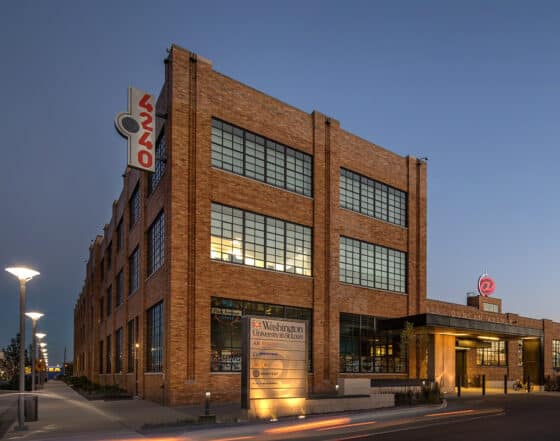
As part of a new wave of biotech innovation, Varro made a deliberate decision to build and scale in St. Louis, selecting CIC St. Louis in the Cortex Innovation District as the home for its custom outfitted shared lab environment.
Turning Breakthrough Science into a Scalable Company
Varro’s technology originated at Washington University in St. Louis, where their early scientific breakthroughs quickly gained traction and funding. As momentum built, it became clear that advancing the technology would require a dedicated environment that could support both research and manufacturing. For Tom and his team, that realization marked a turning point, prompting a return to St. Louis to be closer to the science and talent driving their work.
“I was in New York when we first founded the company,” he says. “And as things started to take off, we realized that there’s a lot of work to do and we were ready to build a physical presence.”
That next step included a significant investment in St. Louis through a new lab and R&D facility designed to support both immediate needs and long-term growth.
Designing a Lab for Complex Scientific Work
To move from innovation to implementation, Varro needed more than standard lab space—they needed an environment that could support complex workflows and evolve alongside the company. Their vision centered on one large space that would bring together research and development, engineering, and manufacturing, with dedicated areas for highly specialized work.
CIC St. Louis provided both the space and the expertise to bring that vision to life. As John Land, General Manager of CIC St. Louis, explains it, “The work our team did with Varro is a perfect example of the CIC model at its best: their work requires highly specialized space, and our role is to remove the pain points of building it so they can focus on bringing that work to life.”
After selecting a large lab space to serve as their central hub, Varro worked with the CIC team to build dedicated rooms for tissue culture with controlled airflow and minimal disruption, electrochemistry labs with specialized ventilation, and PCR rooms designed for isolated workflows. Together, they also installed a custom modular clean room to support sterile, tightly controlled processes. As Tom puts it, “we’ve designed the space so most of the team can work together in a central hub, then branch out into specialized rooms when they need focus or specific environments.”
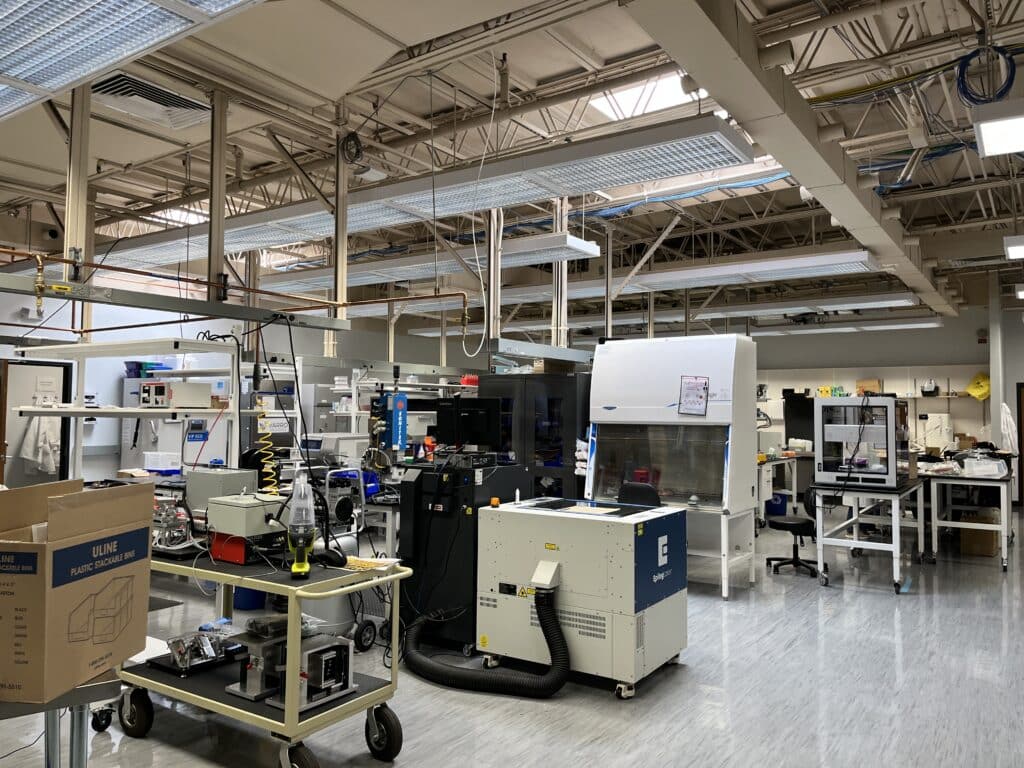
CIC worked closely with Varro throughout the process, tailoring the lab to meet highly specific technical requirements and translating those needs into a fully functional space. Even during construction, Varro maintained momentum by using lab space upstairs to calibrate and intake equipment.
Reflecting on the experience, Tom notes, “CIC was great to work with throughout the modifications. We had to invest a lot to get the space where we needed it, but the facilities team was incredibly supportive and easy to work with, and we were able to make it all come together.”
The result is a fully operational, custom-built lab environment designed for a team of approximately forty people. The space reflects how the team works day to day, bringing people together while also enabling specialized, focused work.
Over time, the lab has become more than just a place to work. As Tom shares, “this space is special. It’s become home for us, and it’s set up exactly how we need it to work.”
As hiring accelerated, Tom recalls how quickly their space needs evolved, “we started out in this lab, and I just kept hiring, and hiring, and hiring. Soon, we needed more space. First, an office down the hall for quiet calls, then anoffice in the other CIC building for when I need some focus time. And now we’re starting to think about where we go from here.”
Rooted in St. Louis, Connected to Opportunity
For Varro, St. Louis offers both scientific depth and strategic opportunity. The region is home to major biotech and pharmaceutical companies, along with Washington University, one of the top NIH-funded research institutions in the country. It also offers a strong talent pipeline, enabling companies to hire locally while attracting experienced professionals drawn by both the opportunity and the quality of life.
Together, these assets create a uniquely supportive environment for biotech talent, where proximity to leading research institutions, established industry players, and a growing innovation community makes St. Louis an especially compelling place to build and scale scientific work.
As John Land, General Manager of CIC St. Louis, puts it, “When a company like Varro chooses to build and grow in St. Louis, it represents a shared win for the region. It’s also further proof that St. Louis offers an incredible range of resources to support rapidly growing companies, even those doing deeply technical work.”
For Varro, these factors play a direct role in building a strong team.
“St. Louis is a great place to build a company,” says Tom. “The schools are excellent, and the city really punches above its weight when it comes to cultural institutions like the art museum, the zoo, the Muny, and Forest Park. These things matter to the people that I want to recruit to come here. In fact, I am getting better people for it.”
Within St. Louis, the Cortex Innovation District, home to CIC St. Louis, stands out as the center of gravity for biotech and innovation, offering both proximity to Washington University and a dense network of collaborators. Given that context, the decision to locate there felt straightforward.
“There really isn’t anything like this anywhere else in St. Louis,” Tom says. “It was always going to be here.”
More Than Space: CIC as an Operational Partner
Supporting innovation means creating an environment where teams can stay focused without being pulled into operational complexity. For Varro, that experience shows up in both everyday details and critical moments.
“It’s a great environment,” Tom says. “The CIC buildings are just always very welcoming to be in. There are snacks. People pay attention to the cleanliness of things. People are always trying to find ways to make it a more accessible, more attractive, more pleasant of a space to be in.”
That sense of support becomes even more important in a highly technical lab setting, where small issues can quickly become distractions. Instead of diverting internal resources, Varro relies on CIC’s team to respond quickly and effectively.
That responsiveness ultimately allows the team to stay focused on their core work. As Tom puts it, “at the end of the day, I want my team to focus on the data, the experiments, and on our Gantt chart, not the lab space, the building, and the parking.”
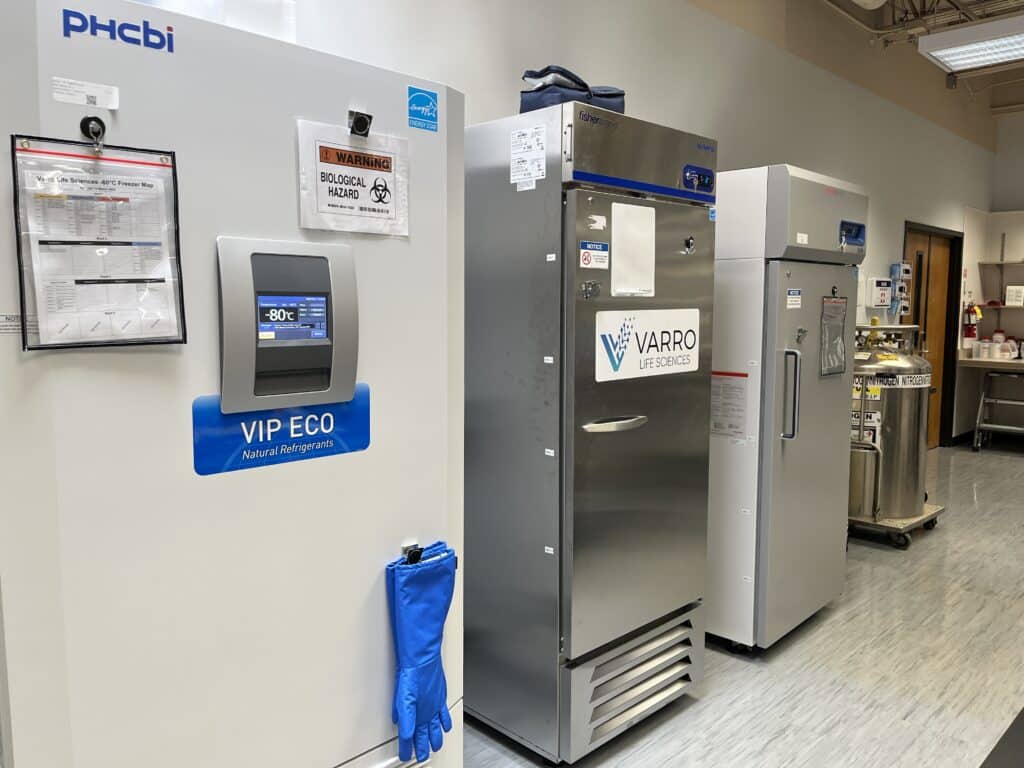
Looking Ahead: Growing Within CIC and Cortex
Over the next five years, Varro is focused on bringing its devices to market and scaling its impact globally. The goal is to create technology that is both widely recognized and immediately understood.
“We’re developing the kind of device that everybody on the planet is going to recognize,” Tom says. “And the first time they see it or they use it, the first thing they’re going to say is ‘Wow, that’s cool. I wish we had that during the pandemic.’”
For Tom, location is just as important. “They’re also going to say, ‘Oh, this is from St. Louis,’” he adds. “Because we’re doing all of it here. I think we have something that St. Louis is going to be really proud of.”
As the company grows, it plans to expand manufacturing locally and distribute its products around the world. CIC and the broader Cortex ecosystem are well positioned to support that growth, offering both flexibility and room to scale without requiring relocation.
Building Environments that Support Innovation
Innovation requires more than breakthrough science. It requires an environment designed to support it from the ground up.
For Varro Life Sciences, that meant building a highly specialized lab tailored to the way their team works and the complexity of their technology.
That’s where CIC came in.
At CIC, we go beyond providing lab space. We partner with teams to design and deliver custom environments that meet precise technical needs, backed by the operational support required to keep work moving forward.
Varro is a clear example of what’s possible with this approach.
When the right space, support, and ecosystem come together, innovation doesn’t just happen. It accelerates. Book a tour and explore our lab spaces in St. Louis and Philadelphia.