The modern commercial real estate landscape offers far more than a single definition of “the office.” Today, organizations can choose from a range of types of offices, from traditional, long-term leases to flexible, service-based environments designed to evolve alongside a business.
At one end of this spectrum, traditional leased offices provide stability and full control. At the other, flexible models like coworking and serviced offices prioritize agility, speed, and reduced operational burden. Between these options, hybrid solutions continue to emerge, giving companies more nuanced ways to align space with strategy. Understanding the different types of offices available is an important first step in navigating this landscape.
Choosing the right office is not just a real estate decision. It is a business decision. The right environment should reflect your company’s stage, support your team’s size, and enable your long-term goals. When workspace aligns with how a business operates and grows, it becomes a catalyst for progress rather than a constraint.
What are the primary types of offices?
There are three primary types of office space: traditional leased offices, serviced and managed offices, and coworking environments. Each model is designed to support different ways of working, from established operations to rapidly evolving teams. These core categories represent the most common types of offices organizations consider today.
These options differ in three key ways:
- The level of control over the physical space and environment
- The structure and scale of financial commitment, including upfront investment and ongoing costs
- The degree of operational responsibility for managing facilities, services, and day-to-day needs
Understanding how these elements come together helps organizations choose a workspace that aligns with their goals. Whether prioritizing long-term stability, built-in flexibility, or a balance of both, the right environment can meaningfully support how teams grow and thrive.
Traditional leased offices
Traditional leased offices represent the most established model in commercial real estate. They offer long-term stability and complete control over the workspace environment.
Typically structured as multi-year agreements (3–10 years), these leases require tenants to take full responsibility for:
- Designing and building out the space
- Installing infrastructure and technology
- Managing utilities, maintenance, and day-to-day operations
This model often involves significant upfront capital investment for fit-outs, along with ongoing overhead costs. In return, companies gain exclusive use of the space and full control over branding and layout.
For established organizations with predictable growth and specific space requirements, traditional office space can offer consistency and autonomy. It may be less adaptable for teams that need to respond quickly to change.
Serviced and managed offices
Serviced and managed offices introduce flexibility into the workplace equation, reducing both setup time and operational complexity.
Serviced offices are fully equipped, plug-and-play environments managed by a third party. They typically include furniture, internet, utilities, and shared amenities, all bundled into a single, predictable monthly fee. With short-term agreements, they enable teams to move in quickly and scale as needed.
Managed offices offer a more customized experience. They combine the branding and layout control of a traditional lease with the convenience of outsourced facility management. These spaces are often designed specifically for a single tenant, allowing for a tailored environment without the burden of managing operations.
In practice:
- Serviced offices prioritize immediate readiness and flexibility
- Managed offices prioritize identity, customization, and ease
Explore options like serviced offices or managed private offices to see how these models and different types of offices can support different growth strategies.
Coworking spaces
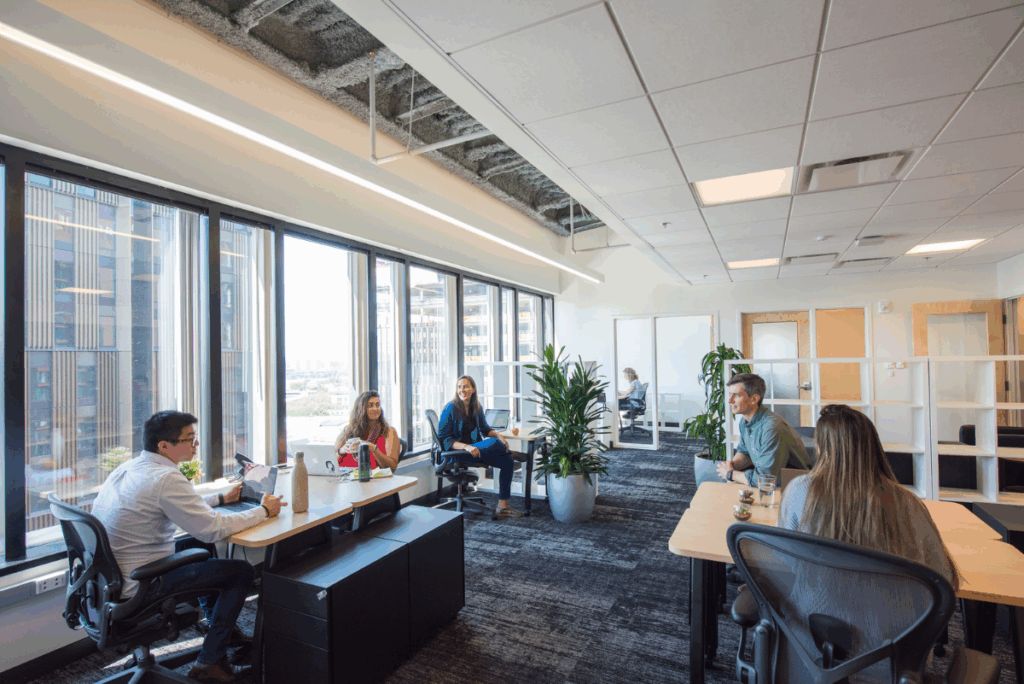
Coworking spaces are shared environments built around community, collaboration, and flexibility. They are especially well-suited for freelancers, startups, and distributed teams looking for connection and adaptability.
These spaces typically offer a range of membership options, including:
- Hot desks, which provide access to available seating on a first-come, first-served basis and allow members to choose a different workspace each day
- Dedicated desks, which offer a reserved workstation for individuals or teams who value consistency within a shared environment
Both options typically include access to shared amenities such as kitchens, conference rooms, and phone booths.
Beyond flexibility, coworking environments support organic networking and knowledge exchange, creating opportunities that extend beyond the workspace itself.
For organizations seeking energy, accessibility, and a strong sense of belonging, coworking offers a compelling alternative to more traditional office setups.

How do different office models compare in financial efficiency and flexibility?
Evaluating office space isn’t just about rent. It is about understanding the total cost of occupancy (TOC). TOC is a comprehensive way to understand what it actually costs to occupy a workspace. It includes not just base rent, but all the expenses tied to running and maintaining that space over time, including operations, services, infrastructure, and everyday needs.
Traditional leases often appear cost-effective on a monthly basis, but they come with significant capital expenditures (CapEx) and additional operational costs, including:
- Utilities
- Cleaning and maintenance
- Furniture and infrastructure
- IT setup and upgrades
These expenses can add up quickly, making the true financial commitment much higher than it may initially seem.
In contrast, flexible office models such as serviced and coworking spaces operate on an operational expenditure (OpEx) model. They offer:
- All-inclusive pricing with one predictable monthly bill
- Minimal upfront investment
- Reduced administrative overhead
Equally important is lease flexibility. Flexible models allow companies to scale up or down with ease, avoiding the constraints of long-term commitments. This is especially valuable for organizations navigating growth or uncertainty and needing to adapt quickly across different types of offices.
To better understand these trade-offs, explore the benefits of a flexible office space.
How to choose the right type of office for your company
Selecting the right office is a strategic process that balances financial realities with long-term operational needs.
A strong decision-making framework should consider:
- Total cost of ownership, not just monthly rent
- Lease flexibility and scalability
- Alignment between space and business operations
The physical environment plays a direct role in business agility. A workspace that supports modular growth allows teams to expand, contract, or reconfigure without disruption.
By contrast, committing too early to a rigid, traditional lease can create friction, especially if the business evolves faster than expected.
The goal is to choose a space that grows with your team, rather than one you outgrow—especially when evaluating multiple types of offices.
Evaluating office infrastructure requirements
Before committing to any space, it’s essential to assess both technical and physical infrastructure.
Key considerations include:
- Internet speed, reliability, and redundancy
- Data security and network capabilities
- IT infrastructure readiness
For companies with specialized needs, such as life sciences or advanced manufacturing, additional requirements may include:
- High-capacity power supply
- Ventilation and safety systems
- Access to turnkey lab space
Verifying these details upfront helps prevent costly adjustments later.
Assessing location factors
Location is more than a logistical choice. It shapes how a company is perceived and how effectively it operates.
A well-chosen office location can:
- Enhance brand image and client confidence
- Improve employee satisfaction and retention
- Support recruitment through proximity to talent pools
Access to public transportation, nearby amenities, and key business hubs all contribute to a smoother daily experience.
In some cases, companies may also consider a satellite office strategy to extend their reach while maintaining flexibility.
What are the common office layouts and configurations?
Office design has evolved significantly, moving from traditional, enclosed layouts to more agile, experience-driven environments.
Today’s workplaces often support a hybrid office model, where employees split time between remote and in-office work. This shift has led to more efficient use of space, supported by systems like hot desking and office hoteling.
Modern workspace layouts and office design strategies focus on flexibility, collaboration, and intentional use of space.
Open-plan versus private offices
Open-plan offices are designed with minimal physical barriers, creating a shared environment where teams work in close proximity. Choosing between open-plan and private offices involves balancing collaboration with focus.
Open-plan offices:
- Encourage communication and teamwork
- Maximize space efficiency
- Can introduce noise and distractions
Private offices:
- Provide confidentiality and quiet
- Support focused, individual work
- Require more space and higher costs
Many organizations adopt a hybrid approach, blending both to support a range of work styles and needs.
Activity-based working
Activity-Based Working (ABW) takes flexibility a step further by designing spaces around tasks rather than roles.
Instead of assigning fixed desks, ABW environments include:
- Quiet zones for focused work
- Meeting rooms for collaboration
- Lounge areas for informal interaction
Employees choose the setting that best fits their task, leading to more efficient space utilization and a reduced need for permanent desks.
This approach not only optimizes square footage, it also supports a more dynamic and responsive workplace culture.
How can CIC support innovation-focused clients with turnkey solutions?
For science and technology companies, the right workspace can meaningfully shape the pace of innovation. At CIC, we design environments that remove friction and support forward momentum.
Our flexible office and lab solutions are built to scale alongside our clients, making it easier for teams to grow, adapt, and stay focused on their work. With turnkey office spaces and pre-built laboratory facilities, organizations can move in quickly and begin operating without the time, cost, and complexity of building from the ground up.
Beyond the physical space, CIC offers access to shared resources, experienced support teams, and a global community of innovators. This connected ecosystem encourages collaboration, accelerates learning, and helps companies move from idea to impact more efficiently.
A workspace should support progress at every stage. Schedule a tour to see how CIC can support your team’s next phase of growth.